The motorcycle communication systems field just got a significant upgrade with the release of the Fodsports FX7. This state-of-the-art Bluetooth mesh intercom is packed with many advanced features and techs. It will revolutionize the way riders communicate and enjoy their rides. Whether you're a solo rider or part of a group, the FX7 offers unparalleled […]

Bluetooth vs. Mesh Motorcycle Intercom: Range, Features and Key Differences
November 2, 2026
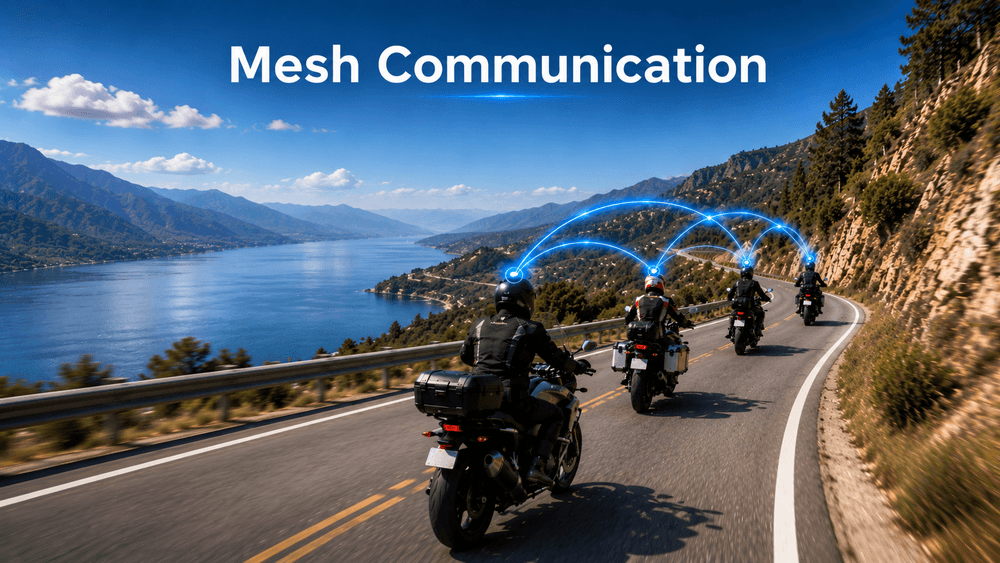
Table of Contents
📡 What Is a Bluetooth Motorcycle Intercom?
A Bluetooth motorcycle intercom is a wireless communication device that allows riders to talk to passengers or other motorcyclists through helmet-mounted speakers and microphones. It typically uses Bluetooth technology to establish connections between compatible communication devices.
Bluetooth intercoms are widely used because they are relatively affordable, easy to operate, and suitable for everyday riding.
How Does Bluetooth Intercom Work?
Traditional motorcycle Bluetooth intercoms establish connections between riders through device pairing. In a multi-rider setup, some systems use a daisy-chain arrangement, where Rider A connects to Rider B, Rider B connects to Rider C, and so on.

For example, imagine four riders traveling together:
- Rider A connects to Rider B.
- Rider B connects to Rider C.
- Rider C connects to Rider D.
This arrangement allows riders to communicate, but it also creates a potential weakness. If a middle rider moves too far away or loses connection, communication between other riders may be interrupted.
The exact connection behavior depends on the manufacturer's intercom design and supported group-pairing technology.
Advantages and Limitations of Bluetooth Intercom
Advantages:
- Affordable compared with many premium Mesh systems.
- Simple pairing for two riders.
- Widely compatible with smartphones and GPS devices.
- Suitable for passenger communication and small riding groups.
- Generally offers good battery efficiency.
Limitations:
- Multi-rider connections can be more complicated to establish.
- Some daisy-chain systems require manual reconnection.
- Communication can be interrupted when riders move out of range.
- Group size is generally more limited than Mesh systems.
Bluetooth remains a practical choice for solo riders, couples, and motorcyclists who mainly need music, navigation, and occasional communication.
🌐 What Is a Mesh Motorcycle Intercom?
A Mesh motorcycle intercom uses a dynamic wireless network to connect multiple riders. Unlike traditional Bluetooth intercom pairing, Mesh communication is designed to maintain group connections as riders move around.
Each compatible device participates in the network, allowing communication to be reorganized when riders temporarily move out of range.
How Does Mesh Communication Work?
Imagine five riders traveling together. Instead of depending entirely on a fixed connection chain, their Mesh devices form a flexible communication network.
If Rider C falls behind or temporarily loses connection, the remaining riders can continue communicating. When Rider C returns within network coverage, the system can automatically reconnect without requiring the entire group to pair again.
This is commonly called a self-healing network.
The biggest advantage is convenience during group rides. Riders do not need to stop frequently to rebuild connections whenever someone changes position.
However, Mesh technology does not eliminate wireless limitations. Buildings, mountains, interference, distance, and device compatibility can still affect communication quality.
Open Mesh vs. Group Mesh
Many motorcycle Mesh intercoms offer two communication modes.
Open Mesh: Allows compatible riders to join an available communication channel. It is useful for motorcycle rallies, organized rides, and larger riding communities.
Group Mesh: Creates a private communication group for selected riders. It is better suited to friends, touring partners, and motorcycle clubs that prefer private conversations.
The number of supported riders depends on the manufacturer and device generation. For example, Sena advertises up to 24 participants for certain Group Mesh configurations, while Cardo's newer DMC systems support groups of up to 31 riders.
These are manufacturer-specific capabilities, not universal Mesh standards.
⚖️ Bluetooth vs. Mesh Intercom: Key Differences
Both technologies allow motorcycle riders to communicate wirelessly, but their connection methods and practical advantages are different.
| Feature | Bluetooth Intercom | Mesh Intercom |
|---|---|---|
| Connection | Traditional pairing | Dynamic network |
| Group communication | Usually small groups | Medium to large groups |
| Reconnection | May require manual action | Usually automatic |
| Connection stability | Depends on pairing arrangement | Designed for flexible group connections |
| Pairing | Often more steps | Usually simpler group joining |
| Range | Model-dependent | Can extend through network relays |
| Compatibility | Relatively broad Bluetooth support | Often brand-specific |
| Price | Generally lower | Generally higher |
| Best for | Couples and small groups | Group rides and touring |
Connection Stability
This is one of the biggest differences.
Traditional Bluetooth intercom systems using daisy-chain connections can experience interruptions when a middle rider leaves the communication range.
Mesh systems are designed to reorganize connections automatically. If one rider temporarily disconnects, the remaining group can continue communicating.
For motorcycle clubs and long-distance group rides, this can significantly reduce communication interruptions and the need for manual reconnection.
Communication Range and Group Size
Bluetooth and Mesh intercom range varies considerably between products.
Some Bluetooth systems advertise communication distances of approximately 500 meters to 2 kilometers under ideal conditions. Mesh systems may extend group coverage through multiple participating devices.
For example, Sena advertises up to 2 km of Mesh communication range between devices under suitable conditions, extendable to 8 km with a group of at least six riders.
However, these figures are manufacturer specifications rather than guaranteed real-world performance. Terrain, buildings, traffic, antenna positioning, and rider spacing can all affect actual range.
Mesh is particularly useful when a group spreads out because participating riders can help extend the communication network.
Pairing and Compatibility
Bluetooth is generally easier to use when connecting different types of devices, including smartphones, GPS units, and compatible motorcycle headsets.
Mesh systems offer convenient group pairing, but compatibility is more complicated.
Different manufacturers may use proprietary Mesh protocols. Even when two devices both advertise Mesh technology, they may not communicate with each other through their native Mesh modes.
For example, Sena Mesh and Cardo Dynamic Mesh Communication (DMC) are different technologies. Riders should check supported compatibility before purchasing equipment for a mixed-brand group.
Battery Life and Price
Traditional Bluetooth intercoms are often more affordable and may offer longer battery life, depending on their hardware and operating modes.
Mesh intercoms can cost more because of their additional networking capabilities and hardware requirements.
However, battery performance depends on speaker volume, intercom usage, Bluetooth connections, audio multitasking, and other features. It is best to compare actual manufacturer battery specifications rather than assuming every Mesh device consumes more power.
🏍️ Which Intercom Is Better for Different Riding Styles?
Neither technology is universally better. The right choice depends on how frequently you ride with other people and how complicated your communication needs are.
Solo Riding
Recommendation: Bluetooth
If you mainly ride alone, you probably do not need Mesh communication. A Bluetooth motorcycle intercom can connect to your smartphone, provide GPS navigation, and play music.
Riding with a Passenger
Recommendation: Bluetooth
For a rider and passenger traveling on the same motorcycle, Bluetooth is usually sufficient. Pairing is straightforward, and there is little need for a large communication network.
Small Groups of 2–4 Riders
Recommendation: Bluetooth or Mesh
Bluetooth works well when riders stay relatively close and maintain a consistent formation. Mesh provides additional convenience if riders frequently change positions or take different routes.
Large Groups and Motorcycle Touring
Recommendation: Mesh
For groups of five or more riders, Mesh offers significant practical advantages. Automatic reconnection, flexible group communication, and network-based coverage make it especially useful for touring and organized rides.
If your group frequently includes different riders, check the network's joining process and brand compatibility before choosing a system.
🔧 Can Bluetooth and Mesh Intercoms Work Together?
Yes, but compatibility depends on the specific devices and connection modes.
Many modern motorcycle communication systems support both Bluetooth and Mesh. They may use Mesh for group communication while using Bluetooth to connect to smartphones, GPS devices, and other accessories.
Some systems also support Bluetooth intercom connections between different brands through universal pairing modes.
However, connecting two Mesh devices from different manufacturers through Bluetooth does not mean their native Mesh networks become compatible. Advanced Mesh functions, automatic group reconnection, and large-group communication may not be available.
Always check the manufacturer's compatibility list before purchasing.
🛒 How to Choose the Right Motorcycle Intercom
Before buying a Motorcycle Intercom, consider these five factors:
1. Group Size: Two riders generally do not need an advanced Mesh system. Larger groups benefit from Mesh connectivity.
2. Riding Habits: Frequent group touring makes automatic reconnection more valuable. For daily commuting, Bluetooth may be sufficient.
3. Compatibility: Check whether the system works with your friends' existing headsets, especially if they use different brands.
4. Audio Quality: Look for suitable helmet speakers, microphone noise reduction, wind-noise control, and audio multitasking.
5. Battery Life and Waterproofing: Compare actual operating time, charging options, and waterproof ratings. These features matter during long-distance rides and unpredictable weather.
Fodsports offers different Bluetooth Intercom, Bluetooth Mesh Intercom, and Helmet Communication solutions for different riding needs. The best choice depends on your riding group, budget, and preferred features rather than simply choosing the newest technology.
❓ Frequently Asked Questions
Is Mesh Intercom better than Bluetooth?
Mesh is generally better for larger riding groups because it supports flexible connections and automatic reconnection. Bluetooth remains a practical and affordable choice for solo riders, passengers, and smaller groups.
Does Mesh Intercom have a longer range than Bluetooth?
Not necessarily for a single device-to-device connection. However, Mesh can extend overall group coverage through participating riders that relay communication.
Can Bluetooth intercoms connect to Mesh intercoms?
Some devices support universal Bluetooth pairing between different communication systems. However, this does not provide full compatibility with the other device's native Mesh network.
Does Mesh Intercom work without a smartphone?
Yes. Motorcycle Mesh intercoms generally communicate directly with compatible headsets without requiring a smartphone or mobile internet connection.
Is Mesh Intercom worth the extra money?
If you regularly ride with large groups, tour over long distances, or frequently experience connection interruptions, Mesh can be worth the additional cost. For solo riding or simple two-person communication, Bluetooth is often sufficient.
Authoritative Sources
- Bluetooth SIG – Bluetooth Mesh Networking Primer
https://www.bluetooth.com/bluetooth-mesh-networking-primer/ - Sena – Bluetooth vs. Mesh Intercom Technology
https://www.sena.com/stories/news/sena-ends-the-debate-between-bluetooth-and-mesh-intercom/
- BMW Motorrad – Difference Between Bluetooth Intercom and Mesh Intercom
https://support.bmw-motorrad.com/s/article/ConnectedRide-Com-P1-Bluetooth-Intercom-and-Mesh-Intercom-20dIj - Fodsports – How Motorcycle Mesh Communication Works
https://www.fodsports.com/blog/how-motorcycle-mesh-communication-works-a-riders-guide-to-mesh-intercom-technology/

Rodney L is a technical writer and product consultant with over a decade of experience in the motor industry. Rodney is a fan of performance machines that run fast and loud and an expert in all things custom. His numerous articles and write-ups are available at our knowledge base. Whether it’s something wrong with your motorcycle or you are building a custom bike, you can trust Rodney’s experience.
You maybe like to read:
Fodsports Brand Month: Unbeatable Deals and Top-Notch Service
Discover Fodsports Brand Month July and August mark a special occasion for motorcycle enthusiasts and tech lovers alike. Welcome to Fodsports Brand Month! This event is dedicated to celebrating everything that makes Fodsports a leading name in the motorcycle communication industry. Get ready for a fantastic promotions, exceptional service from Fodsports. Let's insights into Fodsports' […]
Bluetooth vs. Mesh Motorcycle Intercom: Range, Features and Key Differences
📡 What Is a Bluetooth Motorcycle Intercom? A Bluetooth motorcycle intercom is a wireless communication device that allows riders to talk to passengers or other motorcyclists through helmet-mounted speakers and microphones. It typically uses Bluetooth technology to establish connections between compatible communication devices. Bluetooth intercoms are widely used because they are relatively affordable, easy to […]
Pyrenees Motorcycle Routes in Autumn: A France and Spain Riding Guide
Autumn is an excellent time to explore the Pyrenees by motorcycle, with winding mountain roads, quieter villages, forested valleys, and spectacular views across France and Spain. As summer crowds begin to fade, the region offers a different kind of riding experience, from the legendary Col du Tourmalet to Spain’s scenic N-260 highway. However, an autumn […]
Andalusia Mountain Routes in Autumn: Spain’s Ultimate Motorcycle Riding Guide
Autumn is one of the most rewarding seasons to explore Andalusia, southern Spain, by motorcycle. Winding mountain roads cross golden olive groves, whitewashed villages cling to hillsides, and rugged peaks rise above the Mediterranean. After the intense summer heat, cooler conditions can make longer rides more comfortable and scenic stops more enjoyable. The region also […]
Top 5 Motorcycles for Women in 2026: Cruisers, Sport Bikes and Retro Styles
The best motorcycle for a woman is not necessarily the smallest, lightest, or lowest-powered bike. It is the one that fits her body, riding experience, performance expectations, and personal style. Whether you are a beginner looking for confidence in city traffic or an experienced rider planning weekend road trips, choosing the right motorcycle can make […]