The motorcycle communication systems field just got a significant upgrade with the release of the Fodsports FX7. This state-of-the-art Bluetooth mesh intercom is packed with many advanced features and techs. It will revolutionize the way riders communicate and enjoy their rides. Whether you're a solo rider or part of a group, the FX7 offers unparalleled […]

Dirt Bikes vs E-bikes: Pros, Cons & 2025 Market Insights
August 25, 2025

Dirt biking is no longer about fuel tanks and loud engines come 2025. As electric technology continues to soar in popularity, riders are presented with a difficult decision: should there be an electric dirt bike or a classic gas-powered dirt bike?
Each one comes with its respective benefits and disadvantages. The electric version delivers silent operation, eco-friendly power, and modern style. Gas bikes offer tried-and-true ruggedness, greater range, and the classic ride.
This article explores the pros and cons of both electric and gas dirt bikes, covering performance, durability, ease of use, costs, and market trends in 2025.
Whether you’re a beginner looking for a simple entry point or an experienced rider chasing high-speed adventure, understanding the strengths and weaknesses of each type will help you make the right choice.
Table of Contents
Dirt Bikes vs E-bikes Comparison
| Feature | Electric Dirt Bike ⚡ | Gas Dirt Bike ⛽ |
|---|---|---|
| Energy & Range | 🔇 Quiet, no gas; solar charging possible; range 10–90+ miles | ⏱️ Fast refueling; long range, but noisy and needs gas |
| Durability & Parts | ⚙️ Battery/electronics costly; some parts harder to replace | 🛠️ Proven design; widely available parts; can be rebuilt repeatedly |
| Ease of Use / Learning Curve | 👍 Beginner-friendly; no clutch/gears; smooth instant power | 🎯 Requires clutch & gear skills; steeper learning curve |
| Price Range | 💰 High upfront cost ($1,500–$30k+) | 💵 More affordable initially; used ~$2k, new $7k–$10k |
| Maintenance Costs | 🔋 Minimal routine upkeep; focus on battery/motor; brakes/chains/tires | 🛢️ Frequent service: oil, filters, engine; more consumables |
| Handling & Riding Experience | 🏎️ Lightweight, nimble, instant torque; great for tight trails | 🚵 Heavier, stable at speed; engine braking helps; less agile |
| Transportation & Load | 📦 Lighter, easier to transport; some <100 lbs | 🚚 Heavier; requires trailer or full-size pickup |
| Noise & Stealth | 🤫 Very quiet; less disruptive to wildlife | 🔊 Loud; classic engine roar; disruptive |
| Market Trends (2025) | 📈 Fast-growing; better batteries, smart features; eco-friendly | 🏆 Dominates sales; mature support; ICE tech improving |
1. Energy & Range
Electric dirt bikes run on batteries, so they need no gasoline. They operate silently, avoiding fuel costs and noise. Portable solar chargers can even recharge an e-bike’s battery off-grid.
However, recharging an e-bike takes time; for example, the 2025 SurRon Light Bee X can take about 2 hours to charge from 20% to 80%.
Its range also varies by model: entry-level e-bikes might only go 10–20 miles on a charge, while premium models claim 70–90+ miles. Aggressive riding or high speeds quickly cut that range (often to ~20–30 miles).
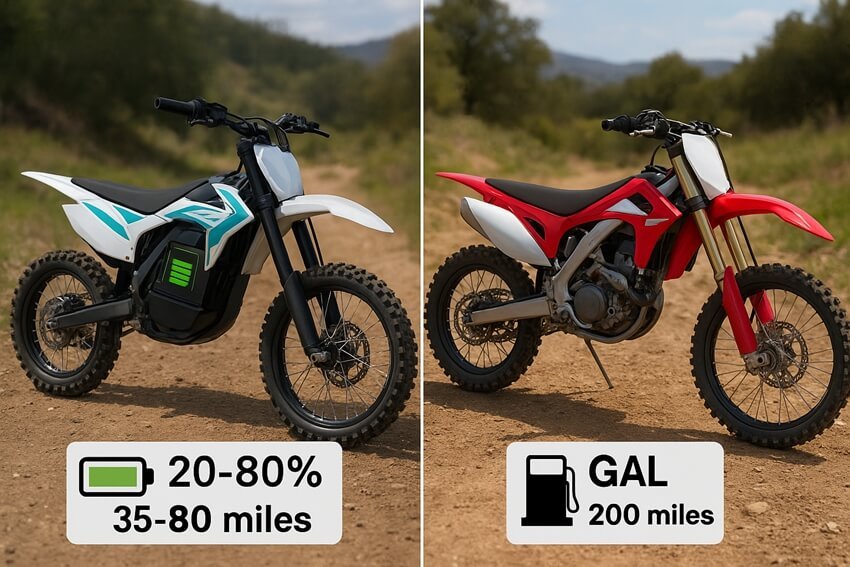
Electric vs Gas Dirt Bike Energy & Range
By contrast, gas dirt bikes refuel in minutes and can run much farther on a full tank. Their extended range and quick refueling make them ideal for long rides or remote areas. Gasoline is also easy to stockpile (with stabilizer) for long-term storage, ensuring you can carry extra fuel if needed. In short:
- Electric Dirt Bike – Pros: Quiet operation; no gas needed (can use solar charging).
- Electric Dirt Bike – Cons: Long recharge time (e.g., ~2h to 80%); range drops sharply with aggressive riding (typically 20–30 miles at high speed).
- Gas Dirt Bike – Pros: Fast fueling; long range per tank; fuel can be stored long-term.
- Gas Dirt Bike – Cons: Noisy; emits exhaust and requires gasoline.
2. Durability & Parts
Gas dirt bikes have decades of engineering behind them, so they tend to be extremely tough. Their engines and frames can be overhauled and rebuilt repeatedly. Importantly, spare parts and service are widely available.
A U.S. market report notes the “wide availability of aftermarket parts and accessories” for ICE dirt bikes, and mechanics experienced with gasoline bikes are common. This means a fuel bike can be kept running indefinitely with routine repairs.
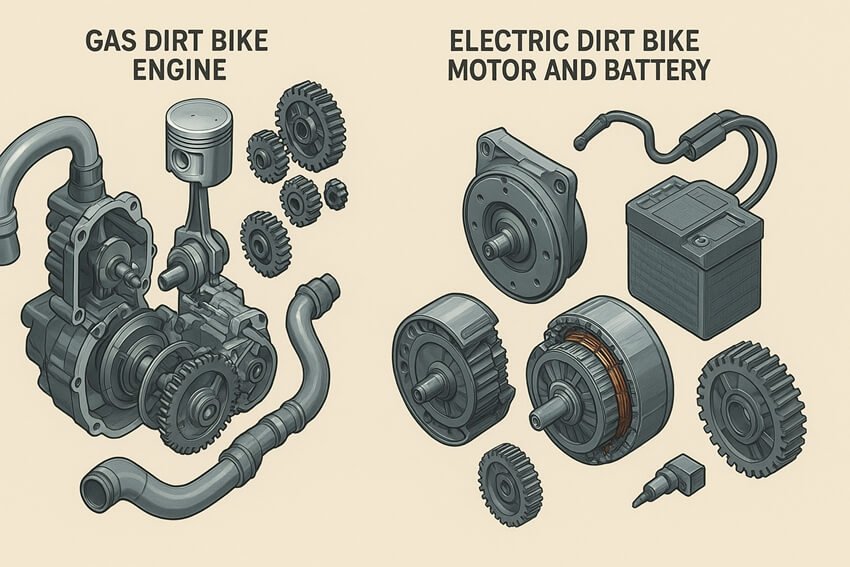
Electric vs Gas Dirt Bike Parts Comparison
Electric motocross bikes have fewer drivetrain components (fewer moving parts), thus fewer parts to wear down. Low-end or early e-bikes sometimes had flimsy parts, but premium e-bikes (e.g., Zero Motorcycles, Stark Varg) now approach gas bike levels of reliability.
Nevertheless, there remain electric-specific parts — most importantly, the battery and the high-voltage electronics — that ultimately wear down and may be expensive or difficult to replace.
In conclusion, ICE bikes are “bulletproof” due to tried-and-true designs and an abundance of parts, while e-bikes are getting better rapidly but may come with long-term parts problems.
3. Ease of Use & Learning Curve
Electric dirt bikes are very beginner-friendly. They have no clutch or manual gears to worry about – you simply twist the throttle and go. The power delivery is smooth and instantaneous, making handling almost as easy as an electric mountain bike. For novices, this plug‑and‑play feel is a huge plus.
Gas dirt bikes require learning clutch control and gear shifts. Two-stroke motocross bikes are very light and powerful, but can be tricky for new riders. Four-stroke bikes run smoother but are heavier and more complex to operate.
In other words, a gas bike has a steeper learning curve (stalling the engine or misshifting is common at first), but mastering it builds real riding skill. So, e-bikes are “on/off” simple, while gas bikes demand more practice with the clutch and throttle.
4. Price Range
Electric models cover a wide price range. Budget e-bikes for youth or casual use may start around $1,500. Mid-range adult e-bikes often cost $2,500–$5,000. Premium performance e-bikes (from brands like KTM Freeride E-XC or Stark Varg) can reach tens of thousands of dollars. Battery packs are a major cost driver.
Gas dirt bikes are generally cheaper to buy. Because the used market is mature, you can find a decent beginner gas bike (125–250cc) for about $2,000. Brand-new mid-range models (250–450cc four-strokes) typically sell for $7,000–$10,000. Notably, research finds electric dirt bikes tend to cost more upfront, while gas bikes are more affordable initially.
In summary:
- Electric Dirt Bikes: ~$1,500 entry up to $20–30k+ for high-end models.
- Gas Dirt Bikes: Used beginner bikes ~$2k; new high-performance models ~$7k–$10k.
5. Maintenance Costs
Gas bikes require regular service. You must change oil, coolant, air filters and spark plugs on schedule, and check valves and fuel systems periodically. Chains, sprockets and tires also wear out with riding. Over time, maintenance parts (oil, filters, cables) add up.
E-bikes need much less routine maintenance: no oil or coolant, and no carburetor or injection system. The main care items are charging and battery health. Brakes, tires and chains still need attention, but the absence of an engine means fewer service intervals.
Electric bikes generally save money on consumables. When the battery or controller eventually needs replacement, though, it can be expensive.
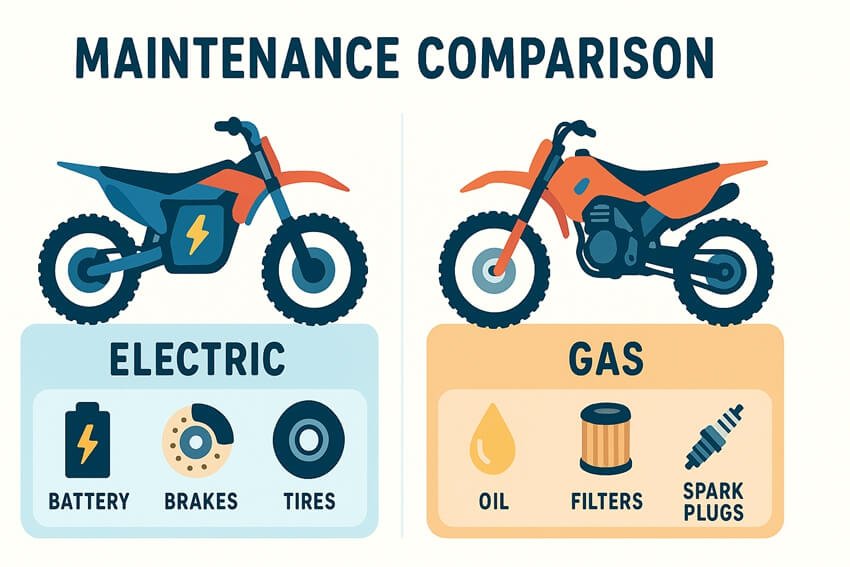
Electric vs Gas Dirt Bike Maintenance
In the long term, a gasoline bike can be rebuilt repeatedly (long-lived), whereas an electric bike’s battery cycle life is a limiting factor.
- Electric Dirt Bikes: Minimal scheduled upkeep (no engine oil changes); focus on battery/motor checks and brake/chain wear.
- Gas Dirt Bikes: Frequent servicing (oil, filters, engine tuning); more consumables and parts to replace.
6. Handling & Riding Experience
Electric bikes ride like lightweight motocross machines. They often feel more nimble than gas bikes because of instant torque and (often) lighter construction. Riders can jump on power smoothly and enjoy responsive handling.
However, some riders note e-bikes can feel a bit “twitchy” at very high speeds since they are lighter, and they lack engine braking (you rely entirely on the brakes).
Gas dirt bikes (especially four-strokes) are heavier, which tends to make them more stable at speed. This extra mass can help the bike absorb rough terrain at high speed. Also, engine braking on a gas bike can be helpful on steep descents.
In practice, electric bikes excel in tight, technical or park-style riding where agility is king, while gas bikes excel on fast, rough trail rides where stability and endurance matter.
7. Transportation & Load
E-bikes tend to be lighter and less cumbersome. Most e-bikes (often less than 100 lbs) will fit on a compact trailer or even hoist into the bed of a truck without hassle. Riders may even be able to use bike racks that are heavy-duty.
Gas bikes tend to be heavier (often 200+ lbs) and will normally need a full-sized pickup truck, trailer, or hitch mount.
When transporting gear, both may employ racks or racks, though electric riders may enjoy the fact that sometimes their bike may fit inside or on a rack better. Overall, e-bikes are generally portable bikes, yet gas bikes tend to need sturdier transport.
8. Noise & Stealth
By design, e-bikes are very quiet. An electric off-roader produces only a low hum at full throttle. This makes them much less disruptive to wildlife and people – an e-bike can sneak up on someone or an animal without alarming them. Gas bikes are much louder; even a few yards away, the roar of a 250cc engine is unmistakable.
In open country, that noise travels far. Interestingly, while e-bikes are acoustically stealthy, their unusual appearance can draw curiosity in some settings.
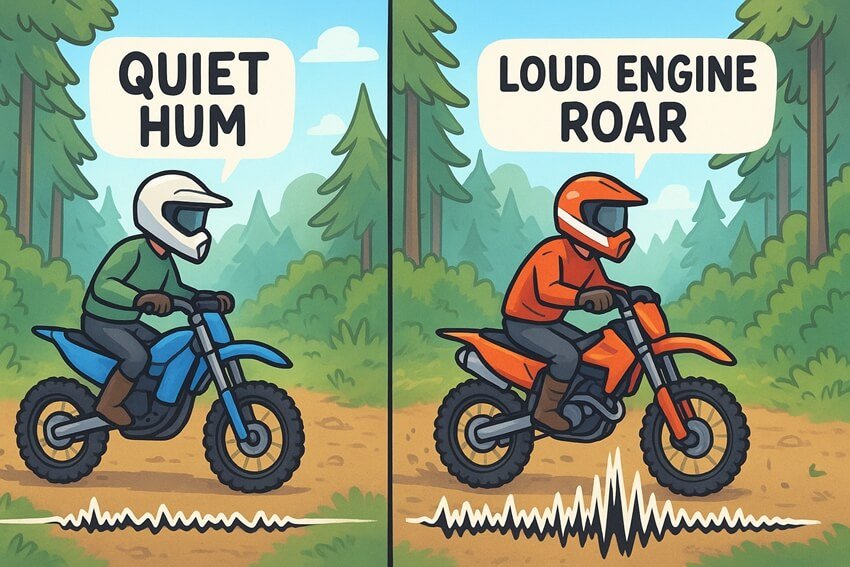
Electric vs Gas Dirt Bike Noise & Stealth
In city trails, for example, people unfamiliar with e-bikes might notice them easily, whereas a gas dirt bike might look more “normal.” But strictly speaking of sound, e-bikes win on stealth and gas bikes are loud.
2025 Market Insights
The dirt-bike market is evolving rapidly. Electric dirt bikes are a fast-growing segment: a 2025 market report estimates the global e-dirt-bike market was about $1.2 billion and will expand to roughly $4.5 billion by 2033 (around a 16.5% CAGR).
Growth is driven by better batteries, smart features (GPS, apps), and eco-friendly trends. Manufacturers are introducing many new electric models – for example, Luna’s Talaria Sting MX5 e-trail bike (2024) offers race-level performance at a relatively affordable price. Similarly, Beta released its new 300 Xtrainer enduro (2024), which combines a refined 2-stroke engine with an electric-like power curve.
Despite this, gasoline bikes still hold the largest share of the market. Reports note ICE dirt bikes dominate U.S. sales because of their proven performance and mature support network. ICE technology is also improving (fuel injection, electronics) to meet emissions rules.
In practical terms, 2025 is seeing both sides advance: electric bikes are growing fast and attracting new riders, while gas bikes remain strong among traditional enthusiasts. Trends like lighter beginner-friendly models and youth programs are helping both categories expand. Governments are even offering rebates or incentives for e-bikes.
In summary, the market outlook is optimistic for both: electric dirt bikes are gaining momentum as technology and demand improve, and gasoline dirt bikes continue to evolve and hold the majority of sales.
Conclusion
Choose whichever works best for you. If quick, short-distance excitement (quiet local trails, immediate acceleration response, minimal hassle) is your style, an electric dirt bike cannot be beat. If long distance, high speeds, or mastering traditional bike skills (clutch control, engine braking) are the requirements, a gas-powered dirt bike will be the better choice.
Riders love both: e.g., warming up on the gas bike with an e-bike or laps around the motocross course. Both ultimately enhance your off-road skills – both markets are active, and both bikes have fair resale/marketing opportunities when the time does come to move on. Either way, getting mud on both tires is the important part!

With over 10 years of experience working on cars and trucks Item Training Supervisor Richard Reina is known around the office as one of our technical experts & real an "automobile person".
His rate of interest began, in his very own words, "at the age of two when his father educated him the distinction in between a Chevy and a Ford. Since then it's been cars regularly."
As a serious lover of practically all things with a motor Richard can address nearly any kind of inquiry related to car upkeep, fixing, or restoration & is a fact professional in electric motor background.
You maybe like to read:
Fodsports Brand Month: Unbeatable Deals and Top-Notch Service
Discover Fodsports Brand Month July and August mark a special occasion for motorcycle enthusiasts and tech lovers alike. Welcome to Fodsports Brand Month! This event is dedicated to celebrating everything that makes Fodsports a leading name in the motorcycle communication industry. Get ready for a fantastic promotions, exceptional service from Fodsports. Let's insights into Fodsports' […]
Bluetooth vs. Mesh Motorcycle Intercom: Range, Features and Key Differences
📡 What Is a Bluetooth Motorcycle Intercom? A Bluetooth motorcycle intercom is a wireless communication device that allows riders to talk to passengers or other motorcyclists through helmet-mounted speakers and microphones. It typically uses Bluetooth technology to establish connections between compatible communication devices. Bluetooth intercoms are widely used because they are relatively affordable, easy to […]
Pyrenees Motorcycle Routes in Autumn: A France and Spain Riding Guide
Autumn is an excellent time to explore the Pyrenees by motorcycle, with winding mountain roads, quieter villages, forested valleys, and spectacular views across France and Spain. As summer crowds begin to fade, the region offers a different kind of riding experience, from the legendary Col du Tourmalet to Spain’s scenic N-260 highway. However, an autumn […]
Andalusia Mountain Routes in Autumn: Spain’s Ultimate Motorcycle Riding Guide
Autumn is one of the most rewarding seasons to explore Andalusia, southern Spain, by motorcycle. Winding mountain roads cross golden olive groves, whitewashed villages cling to hillsides, and rugged peaks rise above the Mediterranean. After the intense summer heat, cooler conditions can make longer rides more comfortable and scenic stops more enjoyable. The region also […]
Top 5 Motorcycles for Women in 2026: Cruisers, Sport Bikes and Retro Styles
The best motorcycle for a woman is not necessarily the smallest, lightest, or lowest-powered bike. It is the one that fits her body, riding experience, performance expectations, and personal style. Whether you are a beginner looking for confidence in city traffic or an experienced rider planning weekend road trips, choosing the right motorcycle can make […]