The motorcycle communication systems field just got a significant upgrade with the release of the Fodsports FX7. This state-of-the-art Bluetooth mesh intercom is packed with many advanced features and techs. It will revolutionize the way riders communicate and enjoy their rides. Whether you're a solo rider or part of a group, the FX7 offers unparalleled […]

Best Motorcycle Helmet Bluetooth Speakers: How to Choose the Right Pair
November 3, 2026
Choosing the best motorcycle helmet Bluetooth speakers involves more than finding speakers that play music. They need to fit your helmet, sit comfortably near your ears, deliver clear audio, and work with your preferred Bluetooth device or communication system.
Some riders mainly want music and GPS directions. Others need phone calls or communication during group rides. The right choice depends on your helmet design, riding habits, and the features you need.
This guide explains speaker types, helmet compatibility, sound quality, installation, and the key factors to consider before buying motorcycle helmet Bluetooth speakers.
🏍️ What Are Motorcycle Helmet Bluetooth Speakers?
Motorcycle helmet Bluetooth speakers are compact speakers designed to fit inside a motorcycle helmet. They let riders listen to music, GPS navigation, phone calls, and other audio without wearing separate headphones.
Most are installed near the helmet's ear pockets and connected to a small Bluetooth communication unit. The unit connects wirelessly to a smartphone or other compatible device, while cables connect it to the helmet speakers and microphone.
It's useful to distinguish between two setups:
- Audio-focused speakers: Designed mainly for music, navigation, and phone audio.
- Intercom system speakers: Part of a complete communication system that may also support rider-to-passenger calls, group intercom, and music sharing.
If you only need audio playback, focus on speaker fit and sound quality. If you want to talk with other riders, look for a compatible communication system rather than judging the speakers alone.
🔊 Types of Motorcycle Helmet Speakers
Helmet speakers vary in size, thickness, and audio design. The best option depends on the space inside your helmet and how you plan to use them.
Standard and Slim Helmet Speakers
Standard speakers are designed for general audio playback. Slim speakers are useful when a helmet has shallow or narrow ear pockets.
A thinner design may make installation easier, but it does not automatically mean better sound. Check the speaker's actual dimensions and make sure it can sit close to your ears without creating pressure.
High-Fidelity Helmet Speakers
Some motorcycle communication systems include speakers designed to provide fuller stereo sound and clearer audio.
For example, certain systems use 40mm speakers. However, diameter alone does not determine performance. Speaker thickness, acoustic design, positioning, and the helmet's interior all affect the listening experience.
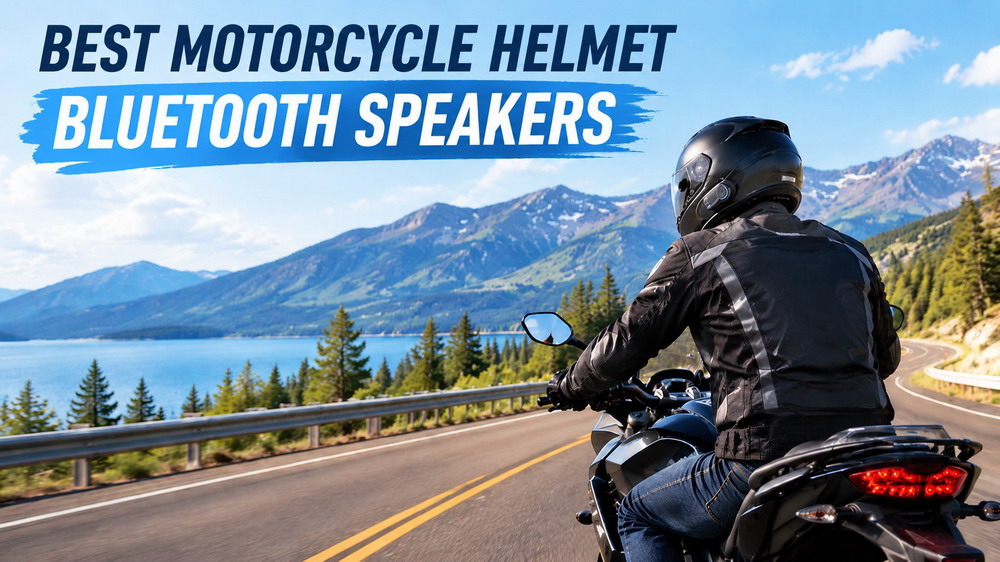
best motorcycle helmet bluetooth speakers
📏 Check Speaker Size and Helmet Compatibility
Compatibility should be one of your first checks before buying. Motorcycle helmets have different interior shapes, padding, and ear-pocket dimensions. A speaker that fits one helmet may be too large or thick for another.
Before purchasing, check:
- The diameter and depth of the helmet's speaker pockets
- The speaker's diameter and thickness
- Whether the cheek pads or liners are removable
- Whether the speaker position aligns with your ears
- The helmet and speaker manufacturers' compatibility guidance
Do not assume that all full-face, modular, and open-face helmets provide the same installation space.
Position Speakers Correctly
Speaker placement affects both comfort and sound clarity. The speakers should sit close to your ears, with their audio surfaces aligned as closely as possible with your ear canals.
If they sit too far forward, backward, or too low, audio may sound less clear. They should also remain secure without pressing painfully against your ears.
A correctly fitting helmet should remain comfortable after the speakers are installed. If the speakers create pressure points or change the helmet's fit, reconsider the positioning or compatibility.
🎧 What Makes a Good Motorcycle Helmet Speaker?
Wind, engine, and traffic noise can affect what you hear while riding. Consider these features when comparing products.
Clear audio: Music, navigation instructions, and voices should be understandable at a comfortable volume. No speaker can eliminate all road and wind noise, so helmet fit and riding conditions matter too.
Speaker design: Compare diameter, thickness, mounting method, and the manufacturer's audio specifications. A larger speaker is not automatically better if it does not fit your helmet properly.
Microphone performance: If you plan to make calls or use an intercom, check the microphone and any stated noise-reduction features. Microphone noise reduction and speaker sound quality are separate functions.
Comfort: Speakers should not press painfully against your ears, especially during longer rides. Check the fit with the helmet on before riding.
Protect Your Hearing
Avoid turning the volume up excessively to overcome wind and traffic noise. The National Institute on Deafness and Other Communication Disorders notes that prolonged or repeated exposure to sounds at or above 85 dBA can cause hearing loss. Motorcycle and dirt-bike noise can reach levels that make hearing protection important.
Keep audio at a moderate level and remain aware of your surroundings. If you cannot hear important traffic sounds or feel the need to turn the volume up excessively, reassess your setup.
📡 Bluetooth Connectivity and Intercom Compatibility
Bluetooth determines how your audio system connects to smartphones, GPS devices, and other compatible equipment.
Depending on the system, features may include:
- Music playback
- GPS navigation audio
- Hands-free phone calls
- Rider-to-passenger communication
- Group intercom
- Music sharing
Not every Bluetooth speaker supports these functions independently. Many features are provided by the communication unit connected to the speakers.
If group riding is important, check the system's supported rider capacity, intercom range, pairing options, and compatibility information.
A Helmet Communication system or Bluetooth Intercom combines speakers with a microphone and communication controls, making it more suitable for riders who need more than music playback.

motorcycle riders bluetooth communication
🔧 How to Install Bluetooth Speakers in a Motorcycle Helmet
Installation methods vary by helmet and product, but these steps provide a general guide.
- Check compatibility: Read the speaker instructions and confirm that your helmet has enough space.
- Access the ear pockets: Remove only the padding designed to be removable, following the helmet manufacturer's instructions.
- Position the speakers: Align them with your ears without creating pressure.
- Secure the speakers: Use the supplied fasteners or mounting hardware as directed.
- Route the cables: Keep wires clear of the helmet's fit, ventilation, retention system, and moving parts.
- Test before riding: Refit the padding, put on the helmet, and check comfort, speaker alignment, and connectivity.
Never cut, drill, or modify the helmet shell or impact-absorbing liner to make room for speakers. NHTSA advises that altering a helmet's interior can compromise its integrity. If installation affects the helmet's fit or safety, consult the helmet manufacturer.
🛒 What to Look for When Buying
Use this checklist to compare motorcycle helmet Bluetooth speakers:
| Buying Factor | What to Check |
| Helmet compatibility | Speaker dimensions and ear-pocket space |
| Speaker thickness | Comfortable fit without ear pressure |
| Sound quality | Clear music, navigation, and voice audio |
| Connectivity | Supported Bluetooth devices and functions |
| Microphone | Voice clarity and noise-reduction features |
| Installation | Mounting method and cable routing |
| Battery life | Runtime of the complete communication system |
| Weather resistance | Manufacturer's stated rating |
| Intercom | Rider-to-rider or group communication support |
Your riding habits should guide the decision. Commuters may prioritize navigation and phone calls. Touring riders may value comfort, battery life, and weather resistance. Group riders should check intercom functions instead of focusing only on speaker specifications.
🏍️ Fodsports Options for Helmet Audio
If you want more than basic audio playback, Fodsports offers motorcycle communication systems that combine helmet speakers, microphones, and Bluetooth or mesh communication features.
The Fodsports FX7 is a mesh communication system with 40mm speakers and support for multi-rider communication. The Fodsports FX8 Pro includes 40mm Hi-Fi stereo speakers, music sharing, and audio support during intercom use.
If you're looking for a complete audio and communication setup, read our guide to the best motorcycle helmet audio system.
❓ Frequently Asked Questions
Can you install Bluetooth speakers in any motorcycle helmet?
Not necessarily. Helmet designs and ear-pocket dimensions vary. Check the speaker dimensions and your helmet manufacturer's guidance before buying.
Are helmet Bluetooth speakers the same as motorcycle intercoms?
No. Speakers provide audio output. A motorcycle intercom system typically combines speakers and a microphone with communication functions such as rider-to-rider conversations.
What size speakers are best for a motorcycle helmet?
There is no universal best size. Some systems use 40mm speakers, but the right choice depends on ear-pocket space, speaker thickness, and positioning.
Can I listen to music and GPS directions through helmet speakers?
Many Bluetooth helmet audio systems support music and GPS audio. Available functions depend on the connected device and communication system.
How can I make my helmet speakers sound clearer?
Position the speakers close to your ears and check that they are securely mounted. Make sure the helmet fits correctly, and avoid using excessive volume to overcome road noise.
🏁 Final Thoughts
The best motorcycle helmet Bluetooth speakers are not necessarily the largest or most expensive. They are the ones that fit your helmet, sit comfortably near your ears, deliver clear audio, and provide the functions you need.
Before buying, compare speaker dimensions, helmet compatibility, installation requirements, connectivity, and sound performance. If you also want to communicate with passengers or other riders, consider a complete Bluetooth communication system.
Choose speakers that fit your helmet and your riding needs.
Authoritative Sources
- National Highway Traffic Safety Administration (NHTSA) — Choose the Right Motorcycle Helmet
https://www.nhtsa.gov/motorcycle-safety/choose-right-motorcycle-helmet - National Institute on Deafness and Other Communication Disorders (NIDCD) — Noise-Induced Hearing Loss
https://www.nidcd.nih.gov/health/noise-induced-hearing-loss - World Health Organization (WHO) — Safe Listening
https://www.who.int/news-room/questions-and-answers/item/deafness-and-hearing-loss-safe-listening - Fodsports — FX7 User Manual and Technical Specifications
https://community.fodsports.com/support/fx7-user-manual/ - Fodsports — FX8 Pro User Manual and Technical Specifications
https://community.fodsports.com/support/fx8-pro-user-manual/

Rodney L is a technical writer and product consultant with over a decade of experience in the motor industry. Rodney is a fan of performance machines that run fast and loud and an expert in all things custom. His numerous articles and write-ups are available at our knowledge base. Whether it’s something wrong with your motorcycle or you are building a custom bike, you can trust Rodney’s experience.
You maybe like to read:
Fodsports Brand Month: Unbeatable Deals and Top-Notch Service
Discover Fodsports Brand Month July and August mark a special occasion for motorcycle enthusiasts and tech lovers alike. Welcome to Fodsports Brand Month! This event is dedicated to celebrating everything that makes Fodsports a leading name in the motorcycle communication industry. Get ready for a fantastic promotions, exceptional service from Fodsports. Let's insights into Fodsports' […]
Best Motorcycle Helmet Bluetooth Speakers: How to Choose the Right Pair
Choosing the best motorcycle helmet Bluetooth speakers involves more than finding speakers that play music. They need to fit your helmet, sit comfortably near your ears, deliver clear audio, and work with your preferred Bluetooth device or communication system. Some riders mainly want music and GPS directions. Others need phone calls or communication during group […]
Bluetooth vs. Mesh Motorcycle Intercom: Range, Features and Key Differences
📡 What Is a Bluetooth Motorcycle Intercom? A Bluetooth motorcycle intercom is a wireless communication device that allows riders to talk to passengers or other motorcyclists through helmet-mounted speakers and microphones. It typically uses Bluetooth technology to establish connections between compatible communication devices. Bluetooth intercoms are widely used because they are relatively affordable, easy to […]
Pyrenees Motorcycle Routes in Autumn: A France and Spain Riding Guide
Autumn is an excellent time to explore the Pyrenees by motorcycle, with winding mountain roads, quieter villages, forested valleys, and spectacular views across France and Spain. As summer crowds begin to fade, the region offers a different kind of riding experience, from the legendary Col du Tourmalet to Spain’s scenic N-260 highway. However, an autumn […]
Andalusia Mountain Routes in Autumn: Spain’s Ultimate Motorcycle Riding Guide
Autumn is one of the most rewarding seasons to explore Andalusia, southern Spain, by motorcycle. Winding mountain roads cross golden olive groves, whitewashed villages cling to hillsides, and rugged peaks rise above the Mediterranean. After the intense summer heat, cooler conditions can make longer rides more comfortable and scenic stops more enjoyable. The region also […]